Film Negative Scanner
Film Negative Scanner Optical Inversion Studio
Hardware Benchmark & Buying Guide

Best Scanner to Scan Negatives: Flatbed vs. Dedicated Scanners

An empirical optical evaluation comparing flatbed scanners, dedicated 35mm CCD units, and digital camera scanning rigs for personal and archival film digitization.

Hardware Selector Engine

Find the Best Negative Scanner for Your Film Archive

Select your archive volume, film formats, and quality priorities to get an objective optical laboratory recommendation.

1. Archive Volume
2. Film Formats
3. Primary Priority
Recommended Setup

Plustek OpticFilm 8200i SE

Dedicated 35mm optical CCD scanner delivering true 3600 optical DPI and hardware infrared dust removal (iSRD).

Optical Sensor Linear 7200 DPI CCD
Dynamic Range 3.6 D_max
36-Exp Roll Time ~45 minutes
Est. Price Range 399 USD

Benchmarked Film Scanner Comparison Matrix

Hardware Model Scanner Type True Optical DPI D_max Range Formats Handled Hardware Dust Removal Price
Plustek OpticFilm 8200i Dedicated 35mm CCD 3600 DPI (effective) 3.6 D_max 35mm strips & slides Yes (iSRD Infrared) 399 USD
Epson Perfection V600 Flatbed Dual Lens 1700 DPI (effective) 3.4 D_max 35mm, 120, Slides Yes (Digital ICE) 349 USD
DSLR / Mirrorless Camera Rig CMOS Area Sensor 4000+ DPI (lens limited) 3.8+ D_max All formats (carrier limited) No (Manual software retouch) 180 to 450 USD
Phone + Screen Lightbox In-Browser WebGL 2.0 1200–2400 DPI 3.2 D_max All formats No (Client-side curve) 0 USD (Free)

1. Understanding Optical Sensor Architectures: Linear CCD vs. Area CMOS

When selecting equipment to digitize analog film negatives, the primary performance bottleneck is not advertised manufacturer resolution, but the optical architecture of the sensor. Manufacturers frequently advertise "7200 DPI" or "9600 DPI", yet optical modulation transfer function (MTF) testing reveals true resolving power between 1500 and 3800 line pairs per millimeter.

Traditional flatbed scanners (such as the Epson Perfection V600 Photo) employ a moving linear Color MatrixCCD carriage beneath a thick glass bed. While versatile for multiple formats, the glass platen introduces chromatic aberration, internal reflections, and Newtonian optical rings when curled film contacts the glass.

2. Dedicated 35mm Scanners: The Plustek OpticFilm Advantage
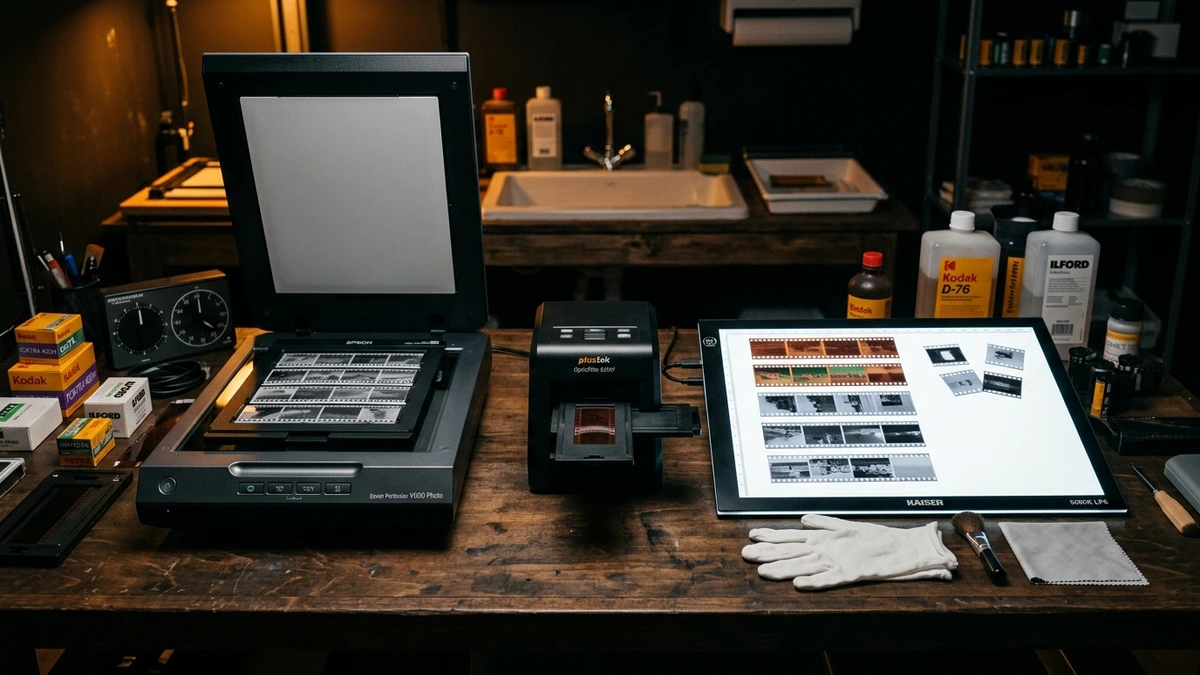
Epson V600 flatbed scanner, Plustek OpticFilm 35mm scanner, and LED light pad on darkroom desk
Hardware Lab Benchmark

For photographers exclusively archiving 35mm film strips and mounted slides, dedicated film scanners such as the Plustek OpticFilm 8200i eliminate the glass platen entirely. The film carrier holds negatives suspended directly in air between the LED illuminator and the optical lens assembly.

Crucially, dedicated units incorporate a secondary 850nm infrared channel (Infrared Smart Removal of Defects / iSRD). Infrared light passes straight through silver halide dye clouds in color negatives while reflecting off surface dust particles and physical scratches, allowing software to automatically heal surface defects without blurring authentic film grain.

3. Camera Scanning: The Modern High-Speed Archival Standard

Over the past five years, professional darkrooms and university archives have overwhelmingly transitioned from flatbed scanners to camera scanning rigs. By mounting a digital camera with a true 1:1 optical macro lens over a 95+ Color Rendering Index (CRI) light table, entire 36-exposure rolls can be captured in under four minutes.

Camera scanning captures full 14-bit or 16-bit raw files with instantaneous shutter actuation, avoiding the motorized stepper motor noise and 45-minute wait times of mechanical scanners. Pairs seamlessly with our in-browser WebGL C-41 color positive inversion engine for immediate color balancing.

4. Hardware Verdict: Matching Equipment to Your Collection

Mixed Format Champion

Epson Perfection V600

349 USD · Flatbed Linear CCD

The undisputed value champion for dual 35mm strips and 120 medium format rolls. True optical resolution reaches ~1700 DPI with ICE defect removal.

35mm Archival Gold Standard

Plustek OpticFilm 8200i

399 USD · Dedicated Optical CCD

Delivers true 3600 DPI optical resolving power without platen glass refraction. Built-in 850nm infrared channel heals scratches without blurring grain.

Maximum Speed & Resolution

Camera Scanning Rig

600 to 1,200 USD · Mirrorless Macro

Captures an entire 36-exposure roll in under 4 minutes at 24–45MP. Zero stepper motor noise; instant RAW ingest into our in-browser C-41 studio.

Zero Cost (100% Free)

Smartphone + In-Browser Studio

100% Free · In-Browser WebGL

Use your existing smartphone camera with our DIY Screen Lightbox Tool for instant family archive digitization.

Frequently Asked Questions

01 Is a flatbed scanner like the Epson V600 good enough for 35mm negatives?

The Epson V600 achieves approximately 1600–1700 true optical DPI on 35mm film, producing sharp 5x7 inch prints and excellent web scans. However, for maximum 35mm grain resolution or large prints, a dedicated 35mm optical CCD scanner (like the Plustek 8200i) or camera scanning rig delivers significantly higher resolving power (3600+ true DPI).

02 What is the difference between flatbed and dedicated film scanners?

Flatbed scanners use a movable glass platen with a moving sensor carriage designed for document scanning, introducing minor optical diffraction through the glass. Dedicated film scanners hold the negative directly in an open optical path between a cold cathode/LED source and a stationary precision linear CCD array, maximizing sharpness and dynamic range.

03 Can I scan film negatives with a digital camera instead of a scanner?

Yes. Camera scanning using a mirrorless or DSLR camera, a 1:1 macro lens, and a high-CRI (95+) light pad is currently the fastest method available, capturing entire rolls in minutes at 24 to 45 megapixels. You can invert camera RAW captures directly in our in-browser C-41 studio.

```