Film Negative Scanner
Film Negative Scanner Optical Inversion Studio
Economic Cost Analysis & Lab Benchmark

Cost to Scan Negatives: Mail-in Services vs. At-Home Scanning

A detailed financial and archival breakdown analyzing mail-in lab fees (ScanCafe, iMemories, local darkrooms) against at-home scanning equipment and zero-cost in-browser tools.

Economic Cost Engine

Film Negative Scanning Cost & Break-Even Calculator

Calculate the exact price of digitizing your film archive via commercial mail-in labs vs. home scanning equipment.

350 Frames
50 frames (~1 roll) 1,000 frames 2,500 frames (~70 rolls)
Film Negative Format:
Resolution Tier:
Commercial Mail-in Lab

ScanCafe / iMemories

158 USD Includes 25 USD insured return shipping
  • Turnaround: 3–4 Weeks
  • Risk: Physical shipping in transit
  • Manual color technician review
Local Pro Darkroom

Custom Photo Lab

332 USD Based on 0.95 USD/frame local rate
  • Turnaround: 5–7 Business Days
  • High-resolution Noritsu / Frontier
  • Local in-person drop-off & pickup
Dedicated Home Scanner

Epson V600 / Plustek 8200i

349 USD Fixed hardware cost (0 USD per frame thereafter)
  • Turnaround: Immediate (at home)
  • Zero shipping loss or damage risk
  • Breaks even at ~780 frames
Zero-Cost In-Browser

Film Negative Scanner

0 USD 100% Free Client-Side Inversion
  • Instant real-time 60fps WebGL
  • 100% private in local browser memory
  • Saves 100% of lab fees immediately
Launch Free Scanner
💡

For an archive of 350 frames, commercial mail-in labs cost approximately 158 USD. If you have over 800 frames, purchasing a dedicated flatbed scanner pays for itself, while our free in-browser scanner saves you the entire 158 USD instantly.

1. The Economics of Analog Film Scanning: Per-Frame Pricing Models

For families and collectors discovering boxes of vintage 35mm strips, APS cartridges, or 120 medium format negatives, the first impulse is often to request quotes from commercial digitizing services. However, film scanning economics operate on steep volume multipliers.

Unlike paper print scanning (which can be fed through automated high-speed document feeder rollers), analog film negatives require individual manual handling, delicate dust blowing, and emulsion orientation verification. Consequently, commercial labs charge from 0.38 USD to 0.85 USD per frame for standard 2000 DPI web resolution, escalating above 1.25 USD per frame for 4000 DPI archival scans.

2. Commercial Laboratory Workstations: Noritsu HS-1800 vs. Fuji Frontier SP-3000
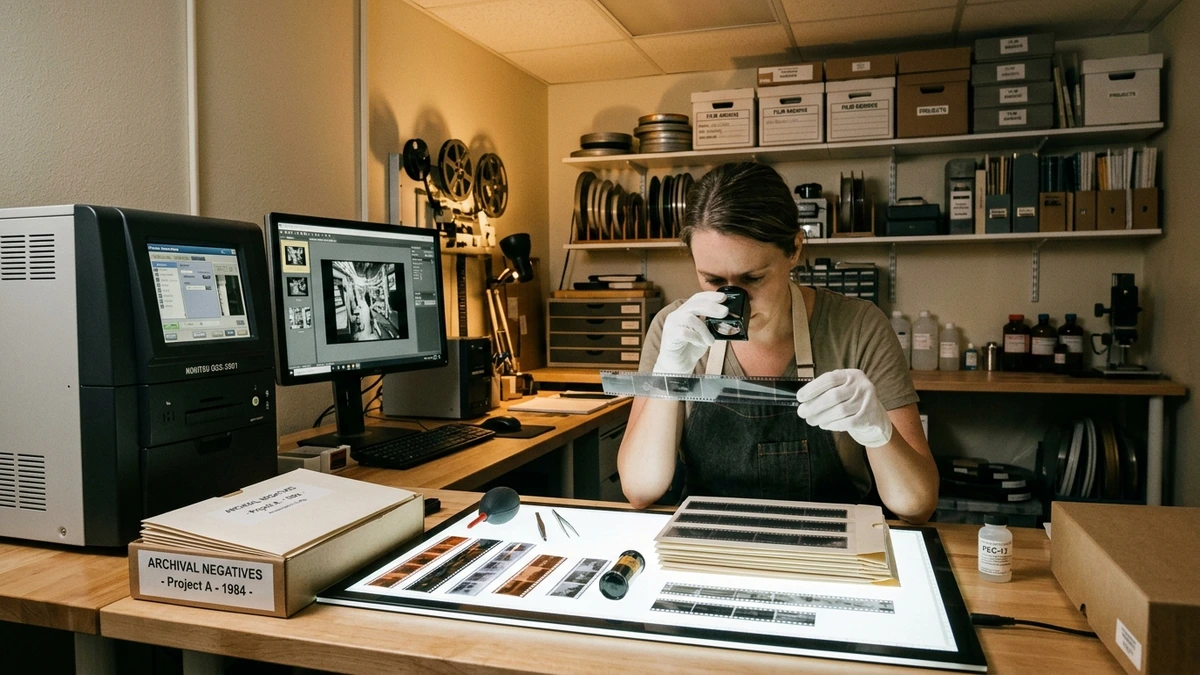
Archival film preservation laboratory technician inspecting 35mm film strips over illuminated light table
Preservation Lab Analysis

Professional photo laboratories (such as Indie Film Lab, The Darkroom, and Richard Photo Lab) utilize dedicated commercial optical scanners originally engineered in Japan during the late 1990s and 2000s. The industry benchmarks remain the Noritsu HS-1800 and the Fujifilm Frontier SP-3000.

These machines feature high-intensity halogen or LED lamps paired with three-line CCD sensors and automated color inversion lookup tables (LUTs) calibrated specifically to Kodak C-41 color paper. While their color output is iconic, laboratory service pricing reflects equipment acquisition costs (between 15,000 USD and 30,000 USD on the secondary market) and trained color technician labor.

3. Transit Risk & The Irreplaceability Factor

Beyond direct per-frame costs, the most significant hidden expense of mail-in scanning is physical transit risk. Irreplaceable family memories from weddings, vacations, and historic events exist as singular physical artifacts: once lost in transit, no amount of insurance compensation can restore them.

By digitizing at home using a digital camera rig, a flatbed scanner, or our free in-browser WebGL scanner paired with a 5500K tablet light pad, your original negatives never leave your hands. You retain 100% custody, zero shipping delay, and complete privacy over personal photographs.

4. Strategic Cost Comparison: Lab vs. DIY Recommendations

Zero Cost (100% Free)

Under 150 Frames (1–4 Rolls)

Total Cost: 0 USD · 100% In-Browser

Use your smartphone camera and our free 3-in-1 Master Negative Scanner. Perfect for casual shoebox discoveries without shipping risks.

Commercial Convenience

150 to 600 Frames

75 to 250 USD · Mail-in Service

Commercial mail-in services (ScanCafe, Digitize Center) provide reasonable convenience if you are willing to risk postal transit for small family archives.

Maximum Break-Even Value

600 to 2,500+ Frames

349 USD Setup · 100% Archival Custody

Investing in an Epson Perfection V600 (349 USD) or a macro camera scanning rig pays for itself on the first large project while keeping negatives safe at home.

Frequently Asked Questions

01 How much does it cost to scan 35mm film negatives at a commercial lab?

Commercial mail-in scanning services like ScanCafe and iMemories charge between 0.38 USD and 0.55 USD per 35mm negative frame at standard 2000 DPI resolution, with 4000 DPI archival scans costing 0.65 to 0.95 USD per frame. Shipping and insured media handling typically add 20 to 30 USD per order.

02 At what point does buying a film scanner become cheaper than a mail-in service?

For collections exceeding 750 to 900 frames (approximately 20 to 25 rolls of 35mm film), purchasing a dedicated flatbed scanner like the Epson Perfection V600 (349 USD) is significantly more cost-effective than commercial mail-in labs. Alternatively, using your smartphone and our free in-browser scanner costs 0 USD regardless of archive size.

03 Is it safe to mail irreplaceable vintage family negatives to online scanning labs?

While reputable mail-in services use tracked shipping (FedEx/UPS), sending one-of-a-kind vintage negatives carries an inherent risk of parcel loss or transit damage. Digitizing at home using camera scanning or our screen lightbox utility guarantees that original silver-halide negatives never leave your possession.

```